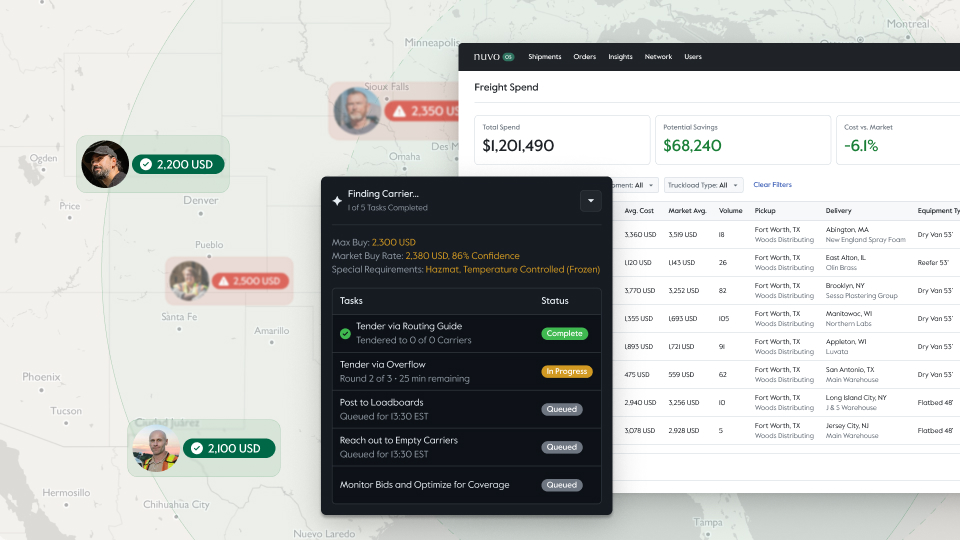
Executive summary Freight execution is under growing strain. As networks expand and service expectations rise, execution risk grows faster than most operating models can absorb. Capacity volatility, fragmented systems, and exception-heavy workflows force teams into constant manual coordination, limiting reliability and obscuring true cost drivers. Agentic AI introduces a new operating model for freight execution. Rather than optimizing individual tasks, agentic systems take responsibility for execution outcomes across the full lifecycle of a load, from procurement and dispatch through tracking, documentation, and financial closeout. These systems persist against defined objectives, escalate when trade-offs require human judgment, and operate within existing carrier and enterprise environments. Early adopters are not using agentic AI to replace teams. They are using it to industrialize execution. By shifting repetitive, time-sensitive, and parallel work from people to agents, organizations improve reliability, accelerate closeout, and create a continuous execution record that enables learning and accountability at scale. This article outlines how agentic freight execution works in practice, where it creates measurable leverage, and how leaders can adopt it safely without disrupting existing operations. What changes when freight execution becomes agentic In most freight organizations, execution is not owned end to end. It is distributed across systems and teams, with responsibility moving from sourcing to dispatch to tracking to closeout. The work between those steps is largely manual and coordination-heavy. That model can function at modest scale. It becomes fragile as volume, geographic reach, and service commitments increase. Agentic execution represents a different operating logic. Rather than optimizing isolated activities, agentic systems are designed to take responsibility for execution outcomes across the full lifecycle of a shipment, from capacity procurement through delivery confirmation and financial closeout, while operating within existing carrier networks and enterprise systems. This approach is now visible in a small number of execution-oriented freight platforms, including providers such as Nuvocargo, that pair AI-driven decisioning with managed operational workflows. The shift is not cosmetic. Instead of supporting teams with better tools, these platforms assume ownership of the day-to-day execution loop and escalate to humans only when trade-offs, risk, or customer context require judgment. For operators, the practical change is subtle but material. Execution no longer depends on individual vigilance. Follow-ups do not rely on memory. Confirmation is not inferred from status fields. Agents persist against defined operational objectives, such as buying capacity at market, validating dispatch readiness, maintaining tracking continuity, and closing documentation, until each objective is resolved or formally handed back to a named owner. How execution agents actually work in practice Agentic freight execution is built around the idea that certain operational tasks are not difficult, but are too frequent, time-sensitive, and parallel for human teams to sustain consistently. AI agents are designed to take on these tasks end to end, using the same channels and constraints humans already operate within. What follows describes how the core agents function at a practical level. Procurement and market-discovery agents What they do in practice When a load is ready to be sourced, procurement agents initiate parallel outreach across a broad carrier network. This typically includes: Sending structured bid requests by email to dozens or hundreds of qualified carriers simultaneously Receiving and parsing inbound responses in real time, regardless of format Following up automatically with carriers that have not responded within defined time windows Engaging in rule-based negotiation through email or voice when price, timing, or service conditions are outside target ranges In time-sensitive scenarios, agents can place outbound calls or voice-assisted interactions to negotiate or confirm availability, operating within pre-approved rate floors, ceilings, and service requirements. Why humans struggle here Human buyers can negotiate well, but they cannot run 50 to 100 simultaneous conversations, monitor responses minute by minute, and re-engage selectively as the market moves. By the time a human closes the loop, capacity has often shifted. What changes for the organization Procurement becomes a continuous, data-driven process rather than a moment in time. Teams define pricing strategy, compliance rules, and escalation thresholds. Agents execute outreach, benchmarking, and negotiation at scale. This increases true price discovery, reduces reliance on first responses, and creates a defensible audit trail of how rates were achieved. Dispatch readiness and confirmation agents What they do in practice Once a carrier is awarded, dispatch agents begin a structured confirmation process: Requesting previous empty time, date, and location through email or voice workflows Calling dispatchers or drivers directly to confirm assignment, equipment details, and readiness Collecting driver phone numbers, truck and trailer IDs through phone-first interactions Confirming ETA and comparing it against appointment windows and distance calculations Repeating outreach automatically if responses are missing or inconsistent If answers change or conflict, such as a new empty time that makes the appointment infeasible, the agent escalates immediately with full context. Why humans struggle here This work is repetitive and unforgiving. Missing a single follow-up can create a late pickup hours later. Human teams rely on memory, notes, and inbox scanning to keep this straight across many loads. What changes for the organization Dispatch confirmation becomes deterministic. The organization no longer depends on individual vigilance to surface risk early. Pickup reliability improves because problems are identified while options still exist. Documentation and financial closeout agents What they do in practice Once delivery is complete, closeout agents take ownership of the administrative tail of the load. Their role is to ensure the shipment reaches financial completion without relying on inbox vigilance or manual chasing. In practice, this includes: Initiating outbound document requests to dispatch and billing contacts immediately after delivery, using predefined communication channels Monitoring inbound emails and uploads for PODs and invoices, regardless of format or naming convention Extracting and validating key fields (dates, signatures, reference numbers, quantities) against shipment execution data Identifying discrepancies between documents and execution facts (for example, delivery time, location, or accessorials) Re-initiating follow-ups automatically based on elapsed time thresholds Escalating unresolved issues with full context when human intervention is required The agent persists until documentation is complete and the shipment is ready for audit and payment. Why humans struggle here This work sits at the intersection of operations and finance and tends to fall through the cracks: It is repetitive, deadline-driven, and easy to defer under operational pressure Document quality varies widely by carrier, requiring interpretation and cross-checking Follow-ups span days or weeks and are difficult to manage consistently at scale Small errors compound into disputes, delayed payment, and working-capital drag As volume grows, teams either accept slower closeout cycles or divert experienced operators into low-leverage administrative work. What changes for the organization Financial closeout becomes a predictable process rather than a backlog risk. Loads move to invoice-ready status faster, improving cash-flow timing. Disputes decrease because discrepancies are identified early, with a complete execution record attached. Operations and finance remain decoupled, each focused on their highest-value work. Execution intelligence and operational traceability What this layer does in practice Across sourcing, dispatch, tracking, and closeout, agentic systems continuously record execution events at the shipment level. This creates a structured operational record that includes: Every bid received, negotiated, accepted, or rejected Every outbound and inbound communication (emails, calls, messages) tied to a specific task Timestamped confirmations, updates, and exceptions Automated and human actions clearly distinguished Outcomes at each stage of the load lifecycle Rather than aggregating data after the fact, intelligence is generated as execution happens. Why traditional operations lack this visibility In most freight organizations, execution data is fragmented: Pricing lives in one system, emails in another, tracking in a third Context is lost when issues escalate across teams Performance analysis relies on partial data or manual reconstruction This limits the organization’s ability to learn from execution, not just react to it. What changes for the organization Accountability becomes structural rather than personal. When something goes wrong, teams can see exactly what happened, when, and why. Execution data becomes usable for performance management, carrier strategy, and process improvement. Leaders gain visibility into systemic issues—recurring lane risk, facility delays, documentation bottlenecks—without relying on anecdotes. Over time, this creates a feedback loop where execution improves because it is measurable, not because teams work harder. Learn more about A new end-to-end operating model for running freight across North America.
Related reading