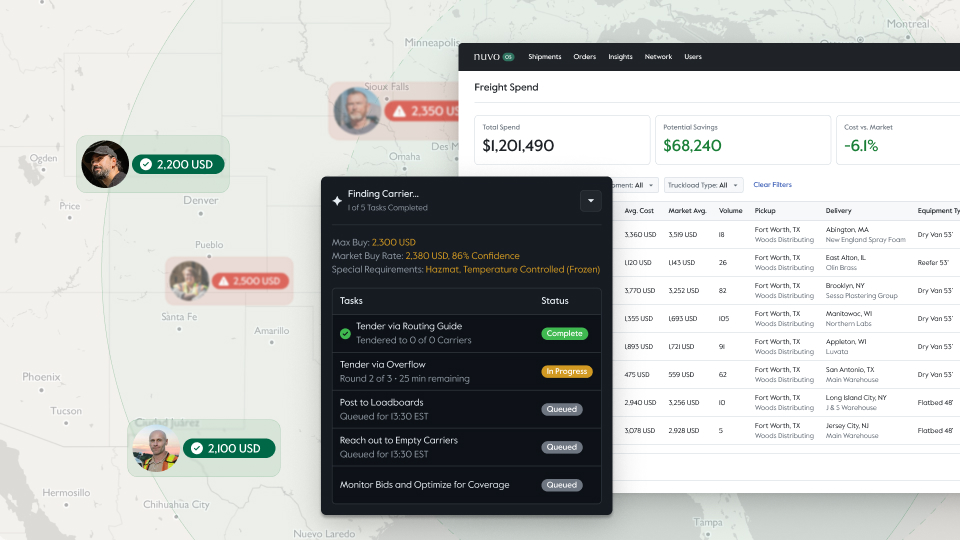
Managed transportation services and a transportation management system (TMS) solve the same problem — running freight more efficiently — but through opposite approaches. A TMS gives your logistics team software to automate tendering, tracking, and reporting. Managed transportation replaces what your logistics team does, providing the technology, the carrier network, and the people to run your freight program. The right choice depends on whether you want to operate freight better or stop operating freight altogether.
Key Takeaways
- TMS = better tools for your team: Automates tendering and tracking, but your team still runs the program
- Managed transportation = replaces the team's execution work: The provider handles daily operations; your team shifts to oversight
- Capital cost difference: Enterprise TMS implementations run $100k–$500k+ upfront; managed transportation has no implementation cost
- Time to value: TMS implementations take 6–18 months; managed transportation transitions take 60–90 days
- Staffing: A TMS requires internal logistics staff to operate it effectively; managed transportation reduces that requirement to oversight
- Decision shortcut: If your team cannot dedicate staff to configure and operate a TMS, managed transportation is the better fit
Side-by-Side Comparison
FactorTMSManaged TransportationWhat it providesSoftware and automationFull operational serviceWho operates itYour internal logistics teamProvider's teamImplementation cost$100k–$500k+NoneTime to operational6–18 months60–90 daysCarrier relationshipsYou build and manageProvider providesOngoing IT requirementSignificantNoneStaffing requirement1–3 dedicated FTEsOversight onlyBest volume fit1,000+ loads/month100–500 loads/monthAccountabilityYour team'sProvider's
When a TMS Is the Right Choice
A TMS makes sense when your company:
- Ships at high enough volume (typically 1,000+ loads/month) that operating a TMS in-house is cost-efficient at scale
- Has a dedicated logistics team with the expertise to configure carrier networks, tendering rules, and rate tables
- Has an IT function capable of managing the implementation and integration
- Wants operational control as a strategic core competency
Large enterprise manufacturers, retailers, and consumer goods companies with established logistics teams typically operate a TMS.
For companies where a TMS is already in place but underperforming, see Why Your TMS Isn't Solving Your Freight Problems — the issue is often operational capacity, not the software.
When Managed Transportation Is the Right Choice
Managed transportation makes sense when your company:
- Ships 100–500 loads per month with a small logistics team (1–5 people)
- Has evaluated a TMS but cannot justify the implementation timeline, capital cost, or internal headcount to run it
- Currently manages freight through multiple brokers with inconsistent visibility and performance data
- Needs operational improvement faster than a TMS implementation allows
Managed transportation providers like Nuvocargo serve US manufacturers and distributors in this range — companies that have outgrown the broker model but are not large enough to justify an in-house TMS operation. See What Is Managed Transportation Services? for a full service model breakdown.
The Hidden Cost of a TMS
TMS sticker price understates the true cost. Implementation fees are the starting point, not the total. Add: internal project management time (often 0.5–1 FTE for 12+ months), data migration, carrier onboarding, staff training, and IT maintenance post-go-live. Industry analysts estimate total cost of ownership for a mid-market TMS at 2–3x the quoted software price over a 3-year period.
Managed transportation converts that capital investment and overhead into a predictable operating expense — and eliminates the staffing requirement to run the system.
Frequently Asked Questions
What is the difference between managed transportation and a TMS?
A TMS is software your team operates to automate freight tasks. Managed transportation is a service where a provider handles those tasks — using their own technology, carrier network, and people. The key difference is who does the work.
Is managed transportation more expensive than a TMS?
On total cost of ownership — including implementation, IT maintenance, and staffing to operate the system — managed transportation is often comparable or less expensive for companies at 100–500 loads per month. A TMS requires capital investment plus ongoing operational overhead; managed transportation is an operating expense with no upfront cost.
Can you use both a TMS and managed transportation?
Yes. Some shippers license a TMS and hire a managed transportation provider to operate it on their behalf — a hybrid model that provides data ownership while outsourcing execution. This is common in larger enterprises planning to eventually bring operations in-house.
How long does a managed transportation transition take compared to a TMS implementation?
A managed transportation transition takes 60–90 days. A TMS implementation typically takes 6–18 months. See What to Expect in the First 90 Days With a Freight Operating Partner for the managed transportation onboarding timeline.
What if I want to eventually move to a TMS after using managed transportation?
This is a viable progression. Many companies use managed transportation to professionalize their freight program — building lane data, carrier relationships, and performance benchmarks — then transition to a self-operated TMS when volume justifies the investment. A managed transportation provider should support this transition rather than create lock-in.
Data Sources
If you're ready to make the switch, our 60-day managed transportation transition guide walks you through every step of the process.
If you're ready to make the switch, follow our 60-day managed transportation transition guide to ensure a seamless handoff from your current freight operations.