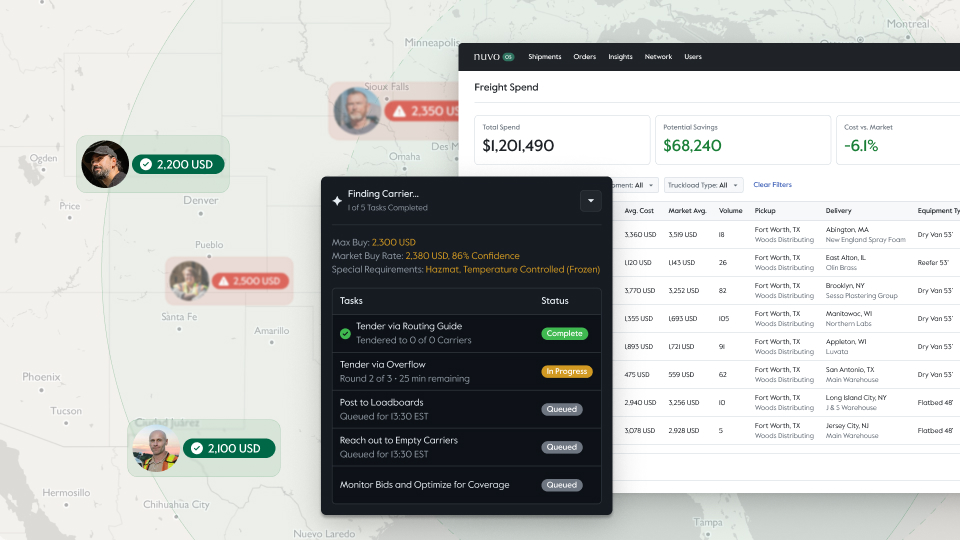
Executive summary Many organizations sustain growth through highly capable teams compensating for fragmented systems. Performance remains strong, but it increasingly depends on manual coordination, localized decision-making, and effort-intensive workflows. As scale and complexity increase through volume growth, acquisitions, or network expansion, the cost of coordination begins to rise faster than the cost of execution itself. What is changing is not the nature of operations, but the tools available to support them. Advances in real-time data, automation, and AI-driven execution now make it possible to coordinate decisions at a scale that human teams alone cannot realistically sustain. This creates an opportunity to improve cost structure and return on invested effort without disrupting what already works. A pattern emerging as organizations scale Across industries, many organizations continue to meet service commitments even as operational complexity increases, largely because experienced teams compensate for fragmented systems through manual coordination, institutional knowledge, and informal workarounds. These approaches persist not because leaders are resistant to change, but because they have proven reliable under pressure. They are flexible, fast to adapt, and capable of handling edge cases that rigid systems often struggle with. From the outside, execution appears stable and dependable. Internally, however, achieving the same outcomes increasingly requires more intervention, more judgment calls, and greater reliance on a small number of experienced operators. Why effort-based execution breaks at scale Effort-driven execution is often a competitive advantage in early growth stages, but it also signals an emerging constraint as organizations scale. As networks expand, coordination requirements grow nonlinearly. Carrier selection, pricing decisions, exception handling, scheduling adjustments, and performance tracking increase not just in volume, but in interdependence. These activities are frequently distributed across spreadsheets, email threads, and individual expertise rather than managed through a unified system. The issue is not operational failure. It is that optimization becomes episodic instead of continuous. Savings opportunities are limited by human bandwidth, and improvements depend on focused initiatives rather than being embedded into daily execution. Over time, effort substitutes for leverage, a dynamic that only becomes visible once scale introduces sustained complexity. How growth changes the economics of decisions Growth does not simply add volume to existing workflows. It increases the number of decisions that must be made, the speed at which those decisions must occur, and the cost of making them with incomplete or outdated information. In freight sourcing, for example, even highly capable teams can engage only a limited number of carriers at a time. Negotiations happen sequentially, while market conditions such as capacity availability, backhaul pressure, weather disruptions, and demand shifts evolve continuously. New execution technologies make it possible to operate under a fundamentally different model, one in which thousands of carriers can be engaged simultaneously, bids evaluated continuously, and decisions adjusted in near real time as conditions change. The advantage is not automation for its own sake, but the ability to scale decision-making itself. Coordination is becoming the real cost center As organizations scale, transportation cost is no longer driven solely by negotiated rates. It is increasingly shaped by how effectively decisions are coordinated across time, lanes, systems, and partners. Fragmented tooling introduces hidden inefficiencies. Data exists, but not in one place. Visibility improves, yet action still requires manual intervention. Teams spend significant time reconciling information across systems instead of using it to make better decisions. The result is higher cost, slower response, and growing dependence on individual heroics to keep operations running smoothly. A different model is quietly emerging Some organizations are responding by consolidating coordination into a single execution layer that operates alongside existing systems rather than replacing them. In practice, this means creating one environment where pricing, negotiation, execution, tracking, and performance measurement are tightly integrated. Real-time data informs decisions as they occur, automation handles repetitive coordination tasks, and human teams retain control over judgment calls and exceptions. Newer platforms, including companies such as Nuvo, are designed around this principle. By combining execution with intelligence, they allow organizations to move away from periodic optimization efforts and toward continuous improvement embedded directly into daily operations. The value is not technical sophistication. It is simpler decision-making with better economics. Learn more about Announcing Nuvocargo’s Acquisition of Merge Transportation.
Related reading